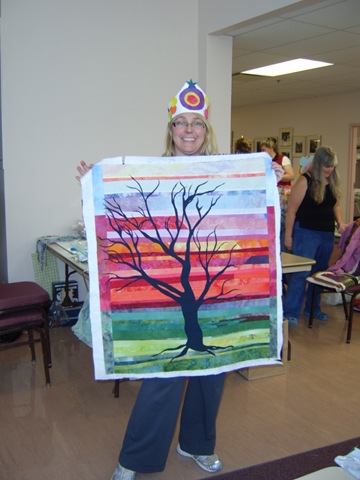
Over the past 4 months, my online Dye Art Group has had an enormous project on the go. 10 of us decided to do a ‘fractured quilt” of a series of canal houses. Our hostess lives in the Netherlands and canal houses are a common architectural design in her country. Last year a smaller group of us did a fractured quilt of a flower which was a lot of fun. This was mine chopped, but before it was sent out. I used paper towel leaves, cheesecloth backgrounds, shrinking thread for the gold center and real (plastic) petals.

The project this year consists of a series of houses that are enormous—so large, I could not get a picture of all of them until I rebuilt the individual pieces in Photoshop. I’ll show you that picture later.
Here is the original design picture:

The hardest part for me was getting the distance from the bottom of the water to the canal walls. I had cut the patterns down just below the seawall so it was difficult for me to judge what the distance was. I eventually had to ask the group, thus letting everyone learn about my dumb error.
So in chronological order, here are my houses:
#1:


Sky—Painted cotton with transparent paint
House—body is hand-dyed fabric with Shiva Stick rubbings. The top of the house has a foam sheet cut-out (the grey part). The windows were made by stitching multi-coloured thread in a grid fashion over water soluble film, then dissolving the film. I then cut out a window shape. The door is Kunin felt with Tyvek stitched over it, then burned with a heat gun to reveal the various colors. It looks much less red in real life.
Water—is a piece of cotton I folded and added green to the peaks.
#2:


Sky—hand painted with Seta Colours.
House—Dyed background and machine stitching in windows.
Water—monoprint, then crunched fabric in SetaColours, cut apart, then restitched.
#3:


Sky—painted cotton. When wet, I threw rock salt on the top to give it the movement.
House—Hand dyed cotton fabric with Shiva Stick rubbings on top. The windows and doors are fused. The railing is made of a cashmere-like yarn.
Water—hand dyed fabric, cut and re-stitched.
#4:


Sky—hand painted. The bird is tinted puffy paint used with a stamp. Other birds are lightly painted in the sky with regular paint to give some depth.
Body—Again, dyed fabric with Shiva Stick rubbings and fusible web windows, doors, etc.
Water—Painted with Seta Colour.
#5:


Sky—Seta Color and rock salt.
House—Soy wax fabric (I think this is a really neato thing). The fence is the only fabric I used in all of the houses that was not made by me. It is a brown velvet that shouted to be used.
Water—It looked awful with the pieced background, so to rescue it I added blue, red and shimmery organza over it.
#6:


Not so happy with what happened here, and will likely ask for it back. Somehow water seeped onto the fabric under the roof and above the window and has left a bad stain. Shoot. This was made with Tyvek windows with Angelina inserts and a fuzzy yarn railing.
#7:


Nothing special here. The door and railings is made with some stamped fabric that is really nice. The deep purple fabric has very faint Yukon fireweed imprints on them.
#8:


This was an interesting and successful technique. The detail on the roof, the windows and door are made using tinted puffy paint. The windows and door were made by pounding a hand made stamp into the tinted puffy paint and applied to the fabric. It was difficult to see the pattern of the windows since the yellow background (shibori pole dyed fabric) and lime green are very similar. After loosely stitching around the windows to suggest a shape, I am more pleased with them. And the water is one of my favourites. Dyed, over dyed, painted, cut and reshaped. I hope this isn’t “too” out of the box for my fellow swappers.
#9:


The most regal piece. I love the puffy paint bird and this is the 3rd piece that has one in the sky. There are smaller puffy fish in the water. The door is embossed metal with red fusible web inserts. The railings are thick black cord stitched down. The house itself is one of my favorite pieces—a sun print with burlap inprints. The roof is soy wax batik fabric.
#10:


Last one—Whew! The haunted house!! I was working on some of these in early October and my thoughts were turned to Hallowe’en. This background fabric looked ominous and thus became the basis for the haunted house. The sky fabric has thread in it to suggest lightening streaks, and I added a rock from the driveway to denote the moon. These were set in with Seta Color paints developed in the sun. I have NO IDEA if my swap sisters will be thrilled or pissed to get this—I hope the swap mistress decides on an appropriate recipient for this piece!
Here they are all together!

And that’s it. It was very labour intensive, very difficult to think up all the different techniques to use on these pieces, but it was well worth it. I can’t wait to see how everyone else’s pieces turned out.